
Ask a GM what drives public support and you'll get a long list. Service, reliability, fares, the budget, whatever made the news last week. All of it matters.
But when everyday folks talk about transit unprompted (no survey, no campaign, nobody asking), the list tends to get a lot shorter. Do I feel safe? Is it clean? Do I feel like I belong in the system? Does it actually get me where I need to go?
For a lot of riders, that's most of the decision. It's also the decision behind whether they'll vote for funding, and whether they'll speak up when someone else is arguing against it.
These are things agencies can actually move the needle on. A visible safety team, a cleaner station, a covered stop, one less transfer. Riders notice, and plenty of them talk about it. The harder part is knowing which of the four is costing you the most right now, and whether what you're putting into it is landing.
Where the Leverage is
We looked at engagement with six U.S. transit agencies (big and small, rail and bus, in very different parts of the country) to see how much of it comes back to those four questions.
Some conversations punch above their weight. At one agency, safety, cleanliness, and whether riders felt welcome came up in about 1 in 5 conversations, but drove about a quarter of all negative engagement. If you’re looking for where effort is most likely to change how people feel about your system, that’s a good place to start.
Knowing which of the four to start with is the harder call. Predict, AlphaVu’s predictive analytics tool, helps us weigh engagement, news coverage, operations data, and reviews into one picture so leadership can see which pillar is under the most pressure and where investment is likely to go the furthest.
Safety
Safety is one of the few topics that skews negative almost by default.
Riders tend to raise safety concerns in the moment, right after something happens or they see something on the train. So, it wasn’t surprising that sentiment toward safety leaned negative at every one of the six agencies we looked at.
What's more useful is what happens around the response. Conversation about security presence (officers, ambassadors, whether anyone's around) runs noticeably cooler than conversation about the incidents themselves. Some of that is “thank you for the extra staff.” Some of it is “where is everybody?” Either way, once the conversation moves from what happened to what the agency is doing about it, the temperature tends to drop.
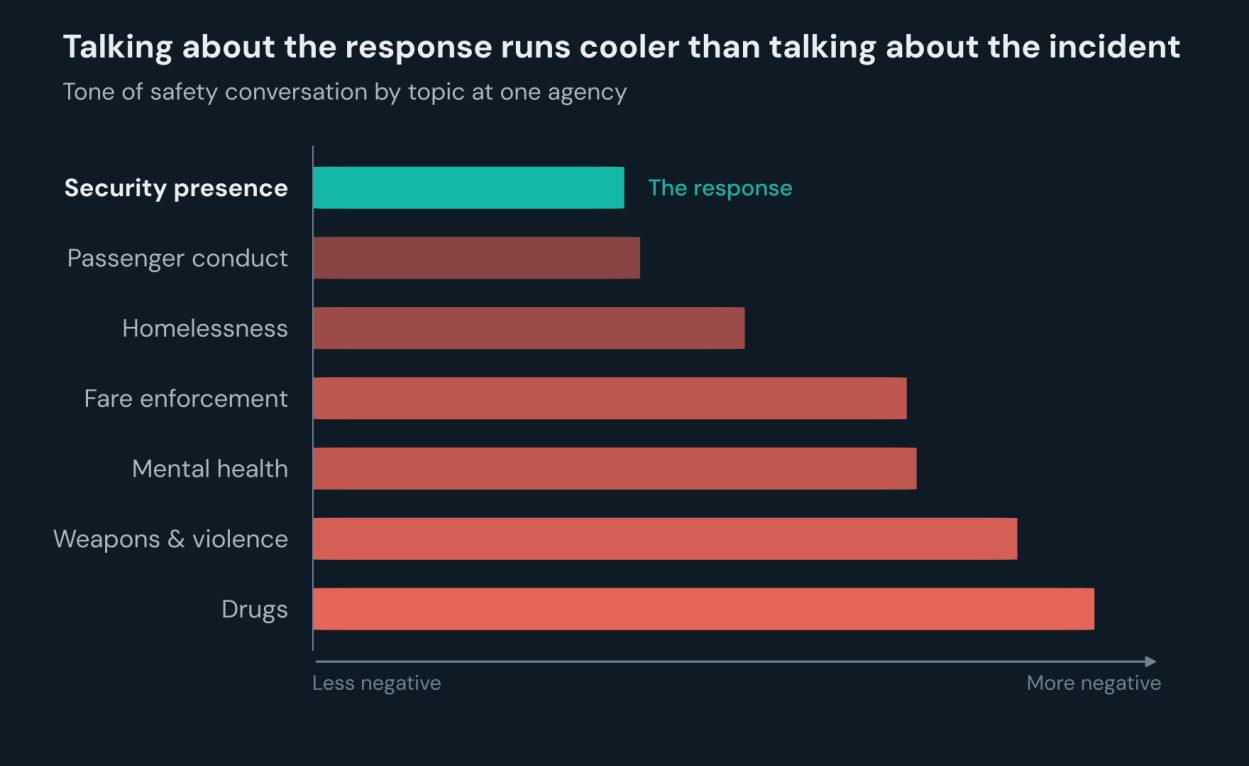
That's something an agency can work with. You can't stop every incident from becoming a post. You can make sure the response is just as visible. Here in DC, GM Randy Clarke has made Metro's safety response hard to miss, often in his own posts. He shares rider safety stories, like how added cameras are helping Metro Transit Police identify suspects, and the payoff: "Customer & staff safety has improved dramatically & that's growing ridership and customer satisfaction." Metro's numbers back him up. Crime is at a multi-decade low, and rail riders’ dissatisfaction with safety has roughly halved while ridership keeps climbing.
Clean
Cleanliness is the lowest volume of the four conversations in the markets we looked at, but it swings the hardest. One bad stretch can turn it sharply negative in a single quarter.
Riders are also pretty clear about what they'll put up with. Conversation about litter and trash is close to neutral sentiment – just reporting to the agency. Bodily fluids, biohazards, and odor are a different story. At the agency where we break it down that far, those were some of the most negative topics in the entire conversation.
So the takeaway is to know which messes riders actually care about, and get to those first.
Welcoming and Accessible
This is where a lot of agencies are already building goodwill. In most of the markets we looked at, it runs more positive than safety or cleanliness.
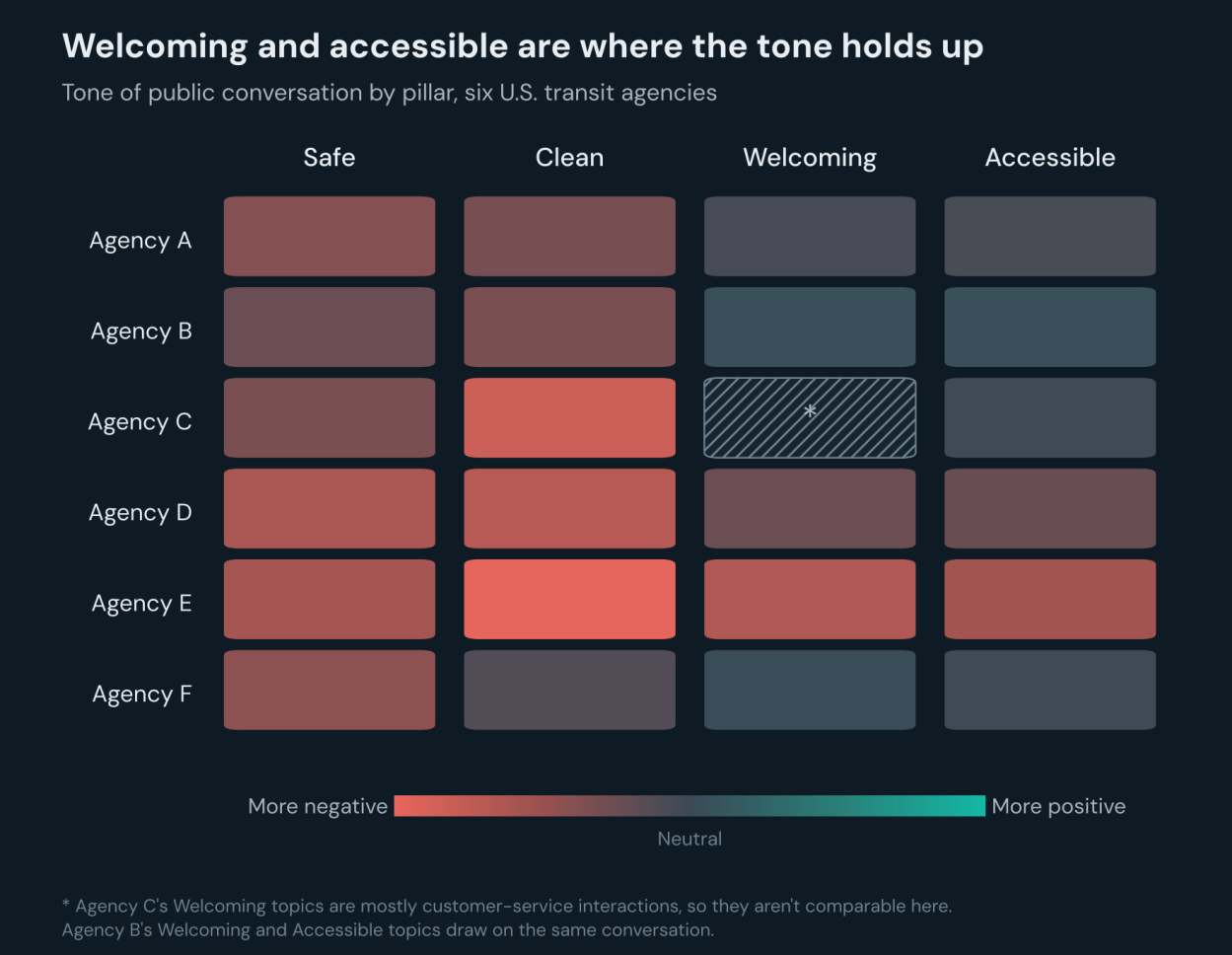
Accessibility here means more than ADA compliance. It's whether you can get to the system, find your way around it, and actually get where you're going. At one agency, it's the biggest of the four conversations by a wide margin.
It also tells you a lot about what riders need. When we helped one agency with a rider journey mapping project, the biggest friction points showed up at the bookends of the trip: planning it, getting to and from the stop, boarding, and especially transfers. That agency is now redesigning its bus network around those friction points, including cutting down on how often riders have to transfer.
This kind of work rarely makes the news the way a safety incident does. But it's a big part of what makes transit feel like a tool for everyday life instead of a last resort, and riders talk about it when it works.
Support it, Ride it, Defend it
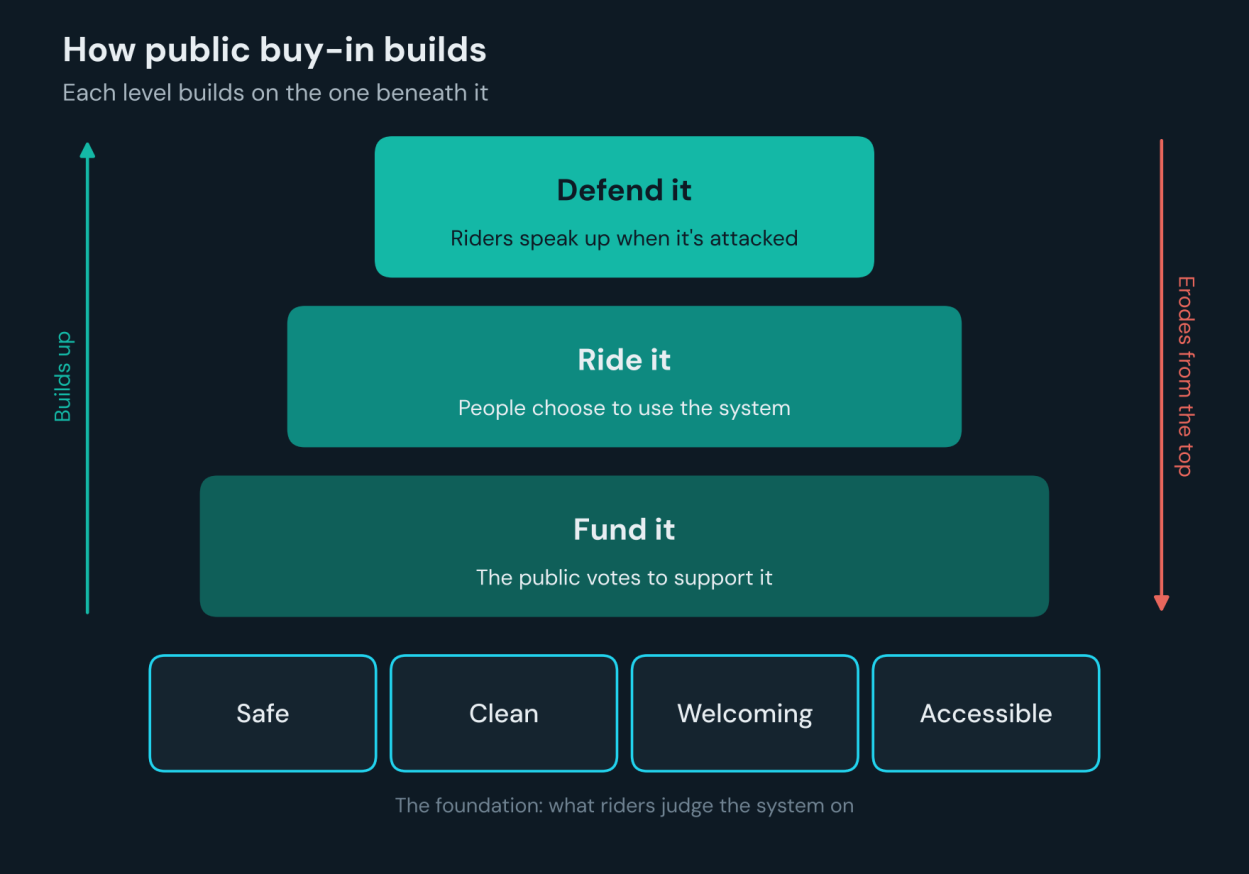
These four things tend to build on each other.
Someone who feels safe and can get where they need to go is more likely to ride. Someone who rides and has a good experience is a lot more likely to support continued investment. And someone who's had enough good experiences is often the person who pushes back when somebody else says transit doesn't work.
Sometimes the link is pretty literal. Multiple agencies we work with are promoting transit as a way to get to the polls on Election Day. During this outreach, one agency's “value of service” score in Predict got a significant boost.
When something breaks, you tend to lose those in reverse. Advocates usually go quiet first. Then the appetite for funding goes. Riders, especially those dependent on the service, are last, and by then it's a much harder problem to fix.
That's also where the opposition aims. If you've ever put a transit measure in front of voters, you've heard it: it's unsafe, it's dirty, it's expensive. That last one is less-so “this tax is a burden on me” and more “why am I paying for something nobody uses?” It lands hardest when the other four already feel broken. Riders with good experiences are one of the best counterarguments an agency has, and an organic voice advocating for your agency often carries more weight than a paid media blast.
Perception Moves People
At one agency, we lined up public conversation about safety against ridership. As perceived safety went down, ridership went down with it. That same agency is now putting its safety personnel front and center in both paid and organic outreach, and the conversation is starting to move. Positive safety conversation is growing, and riders have something to point to besides the most recent incident.
That's the argument playing out in one market. Invest where the conversation tells you to, then watch it change. Get the four right and you're building more than ridership. You're building a community that supports the system and the riders who'll defend it when push comes to shove.
Justin Browning is Senior Insights Analyst at AlphaVu.